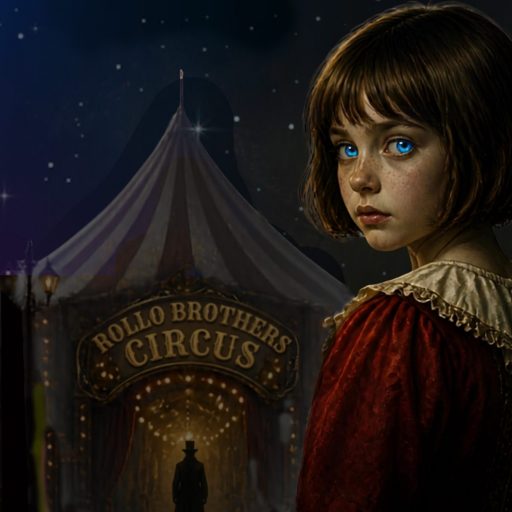
From my earliest days, I understood the changing nature of everything around me. Towns materialized like dreams each morning of my circus childhood. Nameless blurs crystallized into reality as our caravan navigated unfamiliar curves. White-painted boundaries of suburban dreams remained as foreign to me as distant constellations. Instead, my earliest memories are filled with elephant rumbles resonating through wagons. Rhinestones winked in the sun as costumes swayed on makeshift clotheslines between vehicles. Calliope melodies seeped through the walls as sleep claimed me.
Other children had steady landmarks, a corner store’s blue paint, an oak tree’s carved initials. My geography was fleeting. I knew Georgia by the rusty clay that stained my soles orange for weeks. I knew the Carolinas by the briny air that clung to my skin like salt. The Appalachian passes tasted of pine sap and mist. Our home was not a place, but a rhythm: the groan of wagon wheels, the scent of sawdust, and the roar of a crowd. That applause was my true north, the only foundation I needed.
Circuses moved like a nomadic village, with everything we owned designed to fold, collapse, or stack. Trunks of costumes nestled beside cages of drowsy lions. Trapeze rigging disassembled into bundles no thicker than fishing poles. In the 1920s, we snaked across America’s landscape, most shows traveling by chugging train with animals peering from slat-sided cars, and a few shows by convoys of trucks trailing dust clouds. We toured from the first crocuses of March until November’s threat of frost. Summer brought the sweetest touring. No mud to sink in, no blue-lipped performers shivering in leotards, just golden light perfect for drawing crowds.
We were a phantom city, rolling in before dawn and vanishing by midnight, leaving only trampled grass behind. On Sundays in the Bible Belt, our wagons circled up for whispered card games while church bells echoed across the empty midway. Weekdays were a blur of matinee and evening shows. Saturdays stretched us thin with three performances. I’d see the roustabouts rubbing their rope-burned hands, the acrobats moving stiffly from bruises hidden under their spangles. But at night, a stillness fell as we moved to the next town. I understood the bargain we’d all made: to trade a roof for the road and, in return, gain a soul that could never be caged.
As a child, I would wake to the rhythmic chants of the tent crew and roustabouts unfurling the massive canvas of the big top. Voices carried through the walls of our caravan like a prayer to the coming day. Their weathered hands, some missing fingers, gripped the thick lines that would raise our nomadic cathedral.
“Grab a hold; HEAVE HO!” they’d call, muscles straining against sweat-darkened shirts.
“Take up the slack; HEAVE HO!” The canvas snapped taut between them.
“Show em what you got; HEAVE HO!” Faces reddened, veins bulging at their temples and forearms.
“Make it snug; HEAVE HO!” The center pole trembled as it rose, casting a shadow that swept across the trampled grass like the hand of a clock.
“One for the money; HEAVE HO!” Their boots dug into earth still damp with dew.
“To put on a show; HEAVE HO!” The tent finally peaked, a mountain of canvas against the sky.
“And now we can move on. Let it go.” This last part was softer, almost reverent, as if acknowledging the temporary nature of our kingdom.
The circus would often set up in a wide-open field on the outskirts of town, and these lots had their own secret populations. Baby mice threaded the grass like needles through cloth. Tortoises pulled themselves into their shells at our approach, patient as stones. A praying mantis turned its alien head to watch me pass. Rabbits moved from shadow to shadow as if they were hiding from something. Once, a snake crossed my path without a sound, there, then gone, like a rumor of something wild.
The circus lots that doubled as fairgrounds had a magic all their own. I wandered through empty barns and abandoned booths, collecting what the crowds had left behind. Kewpie dolls with snapped-off arms. Tarnished tokens whose games had long since packed up and moved on. Feathers in every color. Fishbowls gone dry and cloudy as cataracts. Small wooden chips worn smooth where a hundred hands had gripped them before mine. Coins half-buried in the dirt, as if the earth itself had been saving them for me.
On sunny mornings, the circus grounds were mine. Mother kept only the youngest ones inside the caravan. With four siblings, I fell neatly into the middle, old enough to slip away unnoticed. I would step outside while the roustabouts were still uncoiling ropes. The big top was nothing yet but a heap of rolled canvas, breathing slowly on the grass. From a safe distance, I watched it rise like something being remembered. I had learned to read its progress the way other children read clocks. As long as the center poles were still earthbound, the morning was mine.
The fun would end when I noticed the big top was up, signaling “school time.” My dad’s whistle would call us home. This was when my mother taught us how to read and write. Our caravan was a cramped wooden box, barely twenty feet long and seven feet wide. Watery sunlight filtered through just two windows: one square porthole beside the kitchen sink and another near the front of the caravan.
By the time we trudged in for “school time,” the bleach Mother had washed with stung our noses. I breathed through my mouth but could still taste it mingling with the bitterness of Mom’s tea. Behind the floral curtain in the corner, someone had forgotten to empty the chamber pot. Five of us crowded around the dinette table, built for four. My elbow wedged against my sister’s ribs, her knee digging into my thigh. My pencil rolled away for the third time as the caravan shifted slightly beneath us, and Mother’s shadow fell across the page.
My mother, Henrietta Viola, towered over us at five foot nine, her showgirl posture never quite abandoned. When her shadow fell across my page, I saw the way her bun pulled the skin tight at her temples. Then she’d turn, and her startling blue eyes would narrow, freezing me mid-sentence. During lessons, Mother’s fingers would curl around the handle of a wooden spoon. My eyes tracked the subtle movements of her hand when I stumbled in my reader. The word “temporary” caught in my throat, and before I could untangle my tongue, the spoon whistled through the air. The crack against my knuckles echoed through our caravan.
“Again,” her voice clipped as a circus barker’s, “and this time, like you have some sense in that head.” The bruises bloomed against our skin, but she’d say, “Knowledge is the only thing no one can take from you.” The bruises faded. The words stayed.
At the end of “school time,” we would all head to the circus cookhouse for lunch. The dining area stood at the far end of the backyard, surrounded by the performers’ caravans and show trucks. The air inside hung thick with the aroma of yesterday’s grease. Trays clattered against the serving table as we shuffled forward in line, the aerialist’s massive shoulders ahead of me and the contortionist’s birdlike frame behind. I ate with my family. After we finished, I’d slip away. Sometimes I went to the lion tamer, who’d press a peppermint into my palm. Other days, I’d find the ancient clown, who would twist a napkin into a bird while his eyes sparkled with secrets from a hundred towns before.
After lunch, my father, Aldo Viola, would take my siblings and me to practice acrobatics. My father was from the old country, Italy. His teaching methods carried the weight of generations. His skin was the color of oiled walnut. His sky-blue eyes sat beneath black hair and brows, a combination that always made him look faintly surprised. He demonstrated each move with the fluid grace of someone born to defy gravity. Though he stood a little shorter than my mother, I watched him once lift my brothers, Sam and Otto, while little Penny balanced on his shoulders. He held their combined weight for thirty seconds before pretending to melt to the ground.
He would always have a stick in his hand, not for striking, but for tapping out rhythms against his thigh as we worked. He occasionally used the stick to correct a slouching shoulder or a misaligned foot. We always started practice with handstands. The blood rushed to our heads as we fought to keep our bodies straight against the side of the caravan.
As a child, I was part of an acrobatic number in the show. The Ringmaster announced with his booming voice that echoed through the big top: “Ladies and gentlemen, children of all ages… the astonishing VIOLA BABIES!” The four of us older kids performed circus knockabout tricks. My siblings and I twisted on the ground in synchronized cartwheels and walkovers that had to land precisely or earn us a stern look. For our finale, my eldest brother supported us all in a human pyramid that swayed slightly with each of our shallow breaths.
My father was a blur of constant motion. At setup, he was a small silhouette against the canvas ceiling, replacing a rope on the big top. By noon, he’d be hunched over the generator, hands greasy, coaxing the machine back to life with Italian curses. During performances, he transformed: first, a fire-eater in a turban, then a juggler and aerial artist. Between acts, he’d slip on a striped apron to hawk popcorn with the same flair. “From the Viola family circus of Italy!” he’d boom at any compliment, his accent thick with pride.
Once rehearsal was over, Mother would bathe me with a cloth and lye soap that burned my eyes, scrubbing until my skin turned raw and pink. “Hold still,” she’d command, her knuckles white around the cloth as she scoured behind my ears. Once deemed presentable, I was banished to the caravan’s dim interior until showtime. At precisely 3:30, Mother’s hands twisted my damp hair into tight ringlets that pulled at my scalp. Our costumes scratched against our freshly scrubbed skin as we wriggled into them. When the calliope music swelled at 4:00, we joined the opening parade called Spec, short for Spectacular. We circled the hippodrome track with our practiced smiles fixed in place.
Our act was right after intermission. Most of the audience was still making their way back to their seats when we started our acrobatic act. As we struck our final pose, the crowd had filled back in. The applause hit us all at once, loud and sudden, like a door thrown open. We held our smiles, muscles burning, until the Ringmaster’s whistle signaled us to exit. Then we’d vanish behind the curtain until the finale, when we’d return to the ring for our final bows.
After a quick dinner in the dining tent, we rested for the eight o’clock show. It was the same act, but transformed by the electric lights from our generator, the light plant. For many small towns, we were the first electricity they’d ever seen. After the final bows, while the crew took down the tent, my siblings and I picked up trash for two dollars a week. Then we’d drive twenty to fifty miles through the dark, ready to start all over again.
By the time I was eleven, we had two new little sisters and four years with Stewart and Marcus’s Three Ring Circus behind us. At the beginning of October, rain had turned the hippodrome track to mud. I watched from the performers’ entrance as my father slipped, his arm folding beneath him at a wrong angle against the wet ground. He finished the show that night.
The next morning, Dad was at Stewart’s wagon before breakfast, his arm wrapped tightly against his chest, hat in hand. I could not hear what was said, but I watched Stewart shake his head twice and close the door.
The circus trucks rumbled away without us that night, their taillights shrinking to pinpricks before vanishing around the bend. We stood beside our lone caravan in the empty field, the flattened grass where the big top had stood just hours before. Dad’s plastered arm gleamed white in the morning light as he fumbled with the map, the corners flapping in the autumn wind.
“Ready,” he finally said, folding the creased paper awkwardly with one hand. “Baltimore, here we come.”
My father’s right arm was broken, so driving wasn’t easy. My oldest brother, Sam, only fourteen, helped him drive home. When Dad pressed the clutch, Sam, beside him, would shift the gears. It was an awkward process at first, but they soon found their rhythm, shifting gears together seamlessly. When we finally arrived in Baltimore, I pressed my nose against the window, stunned by the endless rows of brick buildings that stretched toward the sky. After months of dusty fields and one-street towns, the city’s maze of paved streets felt like another world.
Winter brought frost-covered mornings spent waiting for the school bus, our breaths forming clouds as Sam and Otto wrestled over the last piece of toast. I’d watch from the window as Dad trudged through slush to Mr. Morel’s garage, coming home with grease-stained hands and smelling of motor oil. At night, Mom hunched over the kitchen table under the light, her fountain pen scratching across onionskin paper. “Dear Mr. Ringling,” she’d begin, licking stamps and sealing envelopes addressed to circus managers whose names I’d heard whispered like royalty.

